Understanding the Wimbledon Draw Structure
The Wimbledon singles draws feature 128 players competing in both the gentlemen's and ladies' championships. The draw ceremony takes place on the Friday before the tournament begins, typically late June, when officials reveal the complete bracket structure and determine which players will face each other in first-round matches. This ceremony generates excitement as fans and players alike discover the paths to potential glory or early elimination.
Seeding plays a crucial role in bracket organization at Wimbledon. The All England Club traditionally seeds 32 players in both singles draws, though the specific seeding methodology sometimes differs slightly from ATP and WTA world rankings. Wimbledon has historically used a formula that weighs grass court performance more heavily than standard rankings, though recent years have aligned more closely with official tour rankings while maintaining discretion for exceptional circumstances.
The top two seeds receive the most favorable bracket positions. The number one seed occupies the top of the draw while the number two seed sits at the bottom, ensuring these top players can only meet in the final if both reach that stage. Seeds three and four get placed in the middle sections of the draw, creating four distinct quarters. This distribution prevents the highest-ranked players from meeting until the later rounds, rewarding their season-long achievements.
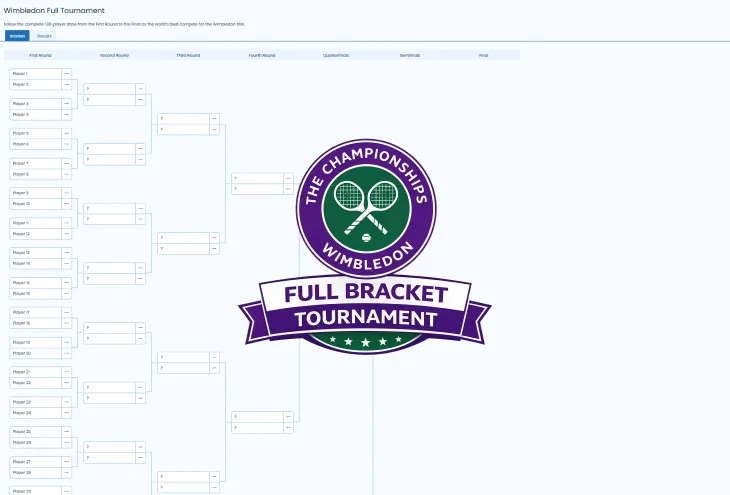
Lower seeds numbered five through 32 fill positions throughout the bracket according to seeding rules designed to balance all four quarters. No two seeds from the same band can appear in the same eighth of the draw. Understanding this structure helps you predict potential matchups before matches begin, as you can see that the number one seed would theoretically face the number 16 seed in the fourth round and the number five seed in the quarterfinals if all higher seeds advance.
The Seven Rounds to Championship Glory
Wimbledon follows a straightforward single-elimination format where defeated players exit immediately while winners advance to the next round. The tournament requires seven victories to claim the championship, with each round progressively eliminating half the remaining field. First-round matches reduce 128 players to 64, second-round matches trim the field to 32, and the progression continues through 16, eight, four, two, and finally one champion.
Traditional tennis terminology defines each round with historic names that reflect the sport's heritage. The round of 128 is simply called the first round, followed by the second round with 64 players. When 32 competitors remain, the round becomes the third round. The round of 16 is designated the fourth round, while the final eight players compete in the quarterfinals. The semifinals feature four remaining players, and the finals determine the champion.
Match scheduling follows a carefully planned structure across the tournament's two weeks. First-round matches begin on the opening Monday and conclude by Wednesday, with 64 matches requiring three days to complete. Second-round matches occur from Wednesday through Friday. Third-round matches take place over the first weekend and the following Monday. The middle Sunday has historically been a rest day, though Wimbledon has occasionally scheduled play on Middle Sunday when rain delays force schedule adjustments.
The tournament intensifies during the second week as the field narrows and matches receive more individual attention. Fourth-round matches occur on Monday and Tuesday of the second week, reducing 16 players to eight. Quarterfinals take place on Tuesday and Wednesday, with two gentlemen's matches and two ladies' matches each day. The semifinals occur on Thursday and Friday, with ladies' semifinals on Thursday and gentlemen's semifinals on Friday. Finals weekend features the ladies' final on Saturday and the gentlemen's final on Sunday, concluding the fortnight of championship tennis.
The 2025 Championships: Recent History and 2026 Preview
The 2025 Wimbledon Championships took place from June 30 through July 13, marking the 138th edition of this historic tournament. The fortnight featured significant changes that modernized the tournament while maintaining its traditional character. For the first time in Wimbledon's long history, electronic line calling replaced human line judges, bringing automated accuracy to every match on all courts throughout the grounds.
The 2025 finals introduced adjusted timing designed to enhance global viewership, particularly in the Americas. Both the ladies' and gentlemen's singles finals began at 4:00 PM local time rather than the traditional 2:00 PM start, with both finals scheduled as the last matches of their respective days. This change reflected Wimbledon's evolving approach to international audiences while maintaining the finals' prominence on Championship Saturday and Sunday.
Jannik Sinner captured his first Wimbledon gentlemen's singles title, defeating two-time defending champion Carlos Alcaraz in the final. Sinner's victory made him the first Italian champion in the Open Era and continued his remarkable 2025 season. Iga Świątek triumphed in the ladies' singles final over Amanda Anisimova, becoming the first Polish Wimbledon singles champion in the Open Era. These historic victories highlighted the sport's evolving landscape as new champions emerged on grass.
The 2026 Championships are scheduled for June 29 through July 12, maintaining the tournament's traditional late June through mid-July timing. The qualifying rounds will take place from June 22-25, determining the final spots in the main draw alongside directly accepted players. Creating your bracket before the tournament begins allows you to make informed predictions once the draw ceremony reveals the complete bracket structure and potential matchup paths.
Seeding Impact and Draw Position Advantages
Seeded players receive significant advantages through favorable bracket positioning at Wimbledon. Top seeds avoid facing other seeded players until at least the third round when they might encounter seeds ranked 17 through 32. The very best seeds don't face another top-16 seed until the fourth round at the earliest. This protection rewards year-long excellence and provides the best players with theoretically easier paths through the early rounds.
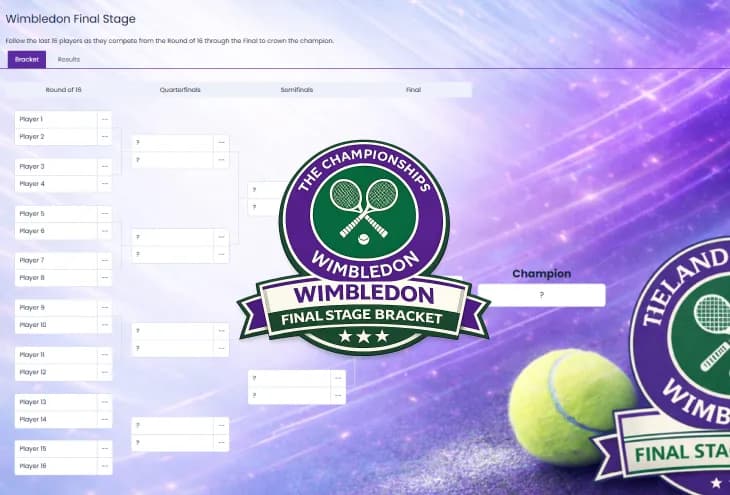
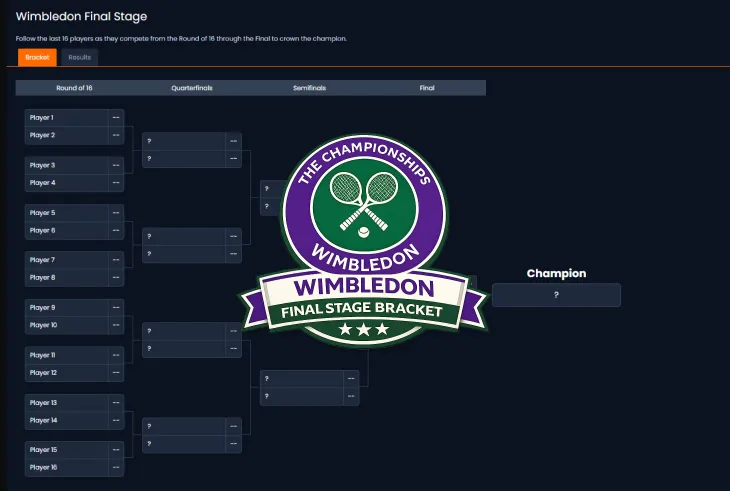
Your Wimbledon bracket clearly displays how seeding affects potential matchups throughout the tournament. The bracket's four quarters each feature a top-four seed who serves as the section leader. If seeding holds perfectly, the number one seed would meet the number eight seed in the quarterfinals, while the number two seed would face the number seven seed. These predetermined collision courses create anticipation for potential classic encounters.
Draw luck significantly impacts championship prospects beyond pure seeding. A top seed might draw a relatively weak quarter where few dangerous unseeded players lurk, creating a smoother path to the semifinals. Conversely, another top seed might land in a loaded quarter filled with former champions, dangerous floaters, or players peaking at the perfect moment. Analyzing your bracket reveals these disparities and helps you identify which players received fortunate draws.
Upsets transform bracket dynamics instantly when lower-ranked players defeat seeds. Your bracket shows how these unexpected results create new potential matchups that differ entirely from pre-tournament predictions. When a major upset occurs, the bracket opens possibilities for unseeded players to reach rounds they might never have accessed if seeds had advanced. These surprises generate excitement and remind everyone that predictions are never guaranteed.
Benefits of Using a Wimbledon Bracket
Creating a Wimbledon bracket transforms your tournament experience from casual watching to active engagement throughout the fortnight. A bracket provides essential structure that helps you understand where matches fit into the overall competition, how results affect future rounds, and which players occupy favorable or difficult draw positions. This organizational clarity makes following 128 players across two weeks manageable and enjoyable.
Tracking favorite players becomes effortless with a bracket that shows their complete potential path through all seven rounds. You can see immediately which players they might face in each round if both competitors advance, allowing you to anticipate exciting matchups several days before they occur. This forward-looking perspective deepens your connection to the tournament narrative as it develops across the fortnight.
Making predictions adds competitive excitement to your Wimbledon experience, especially when competing against friends, family, or coworkers. Fill out your bracket before the tournament begins, predicting winners of every match from the first round through the finals. Compare your predictions with others to create friendly competitions where accurate forecasting earns bragging rights. The unpredictability of tennis ensures even experts struggle to predict every result correctly.
A digital bracket maker offers advantages that paper brackets cannot match. Real-time automatic updates advance players to their next matches as results are finalized, eliminating manual tracking work. Cloud storage protects your bracket from loss or damage, ensuring your predictions and tracking remain secure throughout the two-week event. The Common Ninja Brackets tool provides templates specifically designed for Grand Slam tournaments, making it simple to create professional brackets that enhance your Wimbledon experience.
Following the Action Across All Courts
Wimbledon's unique multi-court structure requires strategic planning to maximize your viewing experience. The All England Club features 18 show courts where simultaneous matches occur throughout most tournament days. Your bracket helps you identify which matches to prioritize when multiple compelling contests compete for your attention during the early rounds when dozens of matches take place each day.
Centre Court serves as Wimbledon's most prestigious venue, featuring the retractable roof that ensures play continues regardless of weather. The 14,979-seat stadium hosts the tournament's biggest matches and most celebrated players. Your bracket helps you track when your favorite players are scheduled on Centre Court, as top seeds typically receive prominent scheduling on the main stadium throughout the tournament.
Court No. 1 provides the second-largest venue with 12,345 seats and its own retractable roof added in recent years. This court hosts high-profile matches involving seeded players and serves as an overflow for contests that would draw large crowds but cannot all fit on Centre Court's schedule. Tracking Court No. 1 matches through your bracket ensures you don't miss significant matches featuring rising stars or dangerous upset threats.
The outer courts create Wimbledon's distinctive atmosphere where fans can watch multiple matches throughout the day with ground passes. Courts numbered 2 through 18 host first and second-round matches simultaneously, creating the tournament's energetic opening week feel. Your bracket helps you navigate these numerous simultaneous matches by highlighting which contests feature seeded players, potential upsets, or intriguing storylines worth following on the smaller courts.
Creating Your Perfect Championship Predictions
Building your Wimbledon bracket begins with thorough research once the tournament draw is revealed. Study each player's recent form, grass court results from earlier in the season, and historical performance at Wimbledon. Some players excel on grass while others struggle with the surface's unique characteristics. Understanding these tendencies improves prediction accuracy and makes matches more meaningful to watch.
Consider the specific draw each player received when making predictions. A top seed with a challenging early-round opponent or a loaded quarter faces different championship odds than a top seed with a favorable path. Analyze potential third and fourth-round matchups for dangerous upset scenarios. Players who historically perform well at Wimbledon but entered with lower rankings create upset potential that bracket analysis helps identify.
Balance conservative predictions with strategic upset picks throughout your bracket. Predicting all favorites to advance creates a boring bracket that lacks differentiation from countless others. However, picking too many unlikely upsets reduces your chances of accurate predictions. Focus upset selections on matches where you genuinely believe the underdog has strong upset potential based on recent form, head-to-head records, or surface-specific strengths.
Customize your bracket to reflect your personal style and tennis knowledge. Some predictors favor powerful servers who dominate on grass, while others believe patient baseline players control points better on Wimbledon's increasingly slower courts. Your bracket should reflect your tennis philosophy and player assessments. Add notes explaining bold predictions or highlighting matches you believe will prove decisive in determining eventual champions.
Prediction Challenges and Competitions
Bracket competitions transform individual predictions into social experiences that enhance tournament engagement. Create competitions with friends, family members, coworkers, or online tennis communities before the tournament begins. Establish clear rules about scoring, deadlines for bracket submission, and potential prizes for the most accurate predictions. These structured competitions increase investment in every match result throughout the fortnight.
Scoring systems typically weight later rounds more heavily to reward correct championship predictions. First-round matches might earn one point each for correct predictions, while second-round matches earn two points, third-round matches earn four points, and so forth through the finals. This exponential scoring ensures that correctly predicting champions matters more than accumulating numerous correct first-round picks, though early accuracy still contributes to overall success.
Multiple scoring variations exist that you can adapt for your Wimbledon bracket competition. Some systems award bonus points for correctly predicting upset victories, defined as lower seeds defeating higher seeds. Others implement confidence pools where participants assign confidence points to predictions, forcing strategic decisions about which picks they trust most. These variations add complexity and strategy beyond simple pick-the-winner formats.
Leaderboards maintain excitement throughout the tournament by displaying standings after each round. Participants can see who leads the competition, which predictions proved most accurate or disastrous, and how many points separate competitors. This ongoing feedback creates momentum as leaders defend positions while trailing participants seek to close gaps through bold predictions or fortunate upset picks in remaining rounds.
Planning Your Viewing Schedule Strategically
Your Wimbledon bracket serves as an essential planning tool for determining which matches to watch throughout the fortnight. Early rounds present dozens of simultaneous matches, making selective viewing necessary unless you plan to watch tennis continuously for twelve hours daily. The bracket identifies matches featuring your favorite players, potential upset situations, or intriguing stylistic matchups worth prioritizing.
Quarterfinal and semifinal matches become must-watch events that your bracket highlights clearly. By this stage, only elite players remain, and every match carries enormous championship implications. The semifinal stage is particularly compelling as four players compete for two finals spots, with the bracket showing exactly which paths led them to this crucial moment and which champion they might face if successful.
Anticipating dream matchups adds excitement to bracket following as the tournament progresses. If two rivals or contrasting styles advance on a collision course toward a quarterfinal or semifinal meeting, you can plan days in advance to ensure viewing availability. This forward-looking capability transforms bracket following from results checking into strategic tournament appreciation where potential future matchups generate as much interest as completed matches.
Rain delays and schedule adjustments are inevitable at Wimbledon despite the retractable roofs on Centre Court and Court No. 1. Your bracket helps you stay organized when weather disrupts the schedule by showing which matches still need completion and how delays affect subsequent rounds. Flexibility in your viewing plans accommodates these unpredictable elements while ensuring you catch the most important matches whenever they occur.
Analyzing Form and Surface-Specific Performance
Grass court tennis requires unique skills that not all players possess equally. The surface's low bounce and faster pace favor players with strong serves, excellent volleying ability, and comfort attacking the net. Your Wimbledon bracket predictions should account for these surface-specific strengths, as clay court specialists often struggle at Wimbledon while grass court experts exceed their rankings.
Pre-Wimbledon grass court tournaments provide crucial form indicators for bracket predictions. Events at Stuttgart, 's-Hertogenbosch, Halle, and Queen's Club occur in June and showcase which players have adapted well to grass. Strong performances or early exits at these tournaments signal form levels heading into Wimbledon. Incorporating this recent grass court data improves prediction accuracy over relying solely on year-round rankings.
Historical Wimbledon performance reveals which players consistently excel at the All England Club regardless of their ranking entering the tournament. Some players reach the second week almost every year despite inconsistency elsewhere, while others repeatedly disappoint despite high seedings. Studying past results helps identify these patterns and adjust predictions accordingly to account for players who elevate or struggle specifically at Wimbledon.
Match scheduling and rest days affect player performance in ways your bracket tracking helps you monitor. Players who complete early-round matches quickly in straight sets enjoy more recovery time than those who battle through lengthy five-set encounters. These accumulated rest advantages or disadvantages influence later-round results, particularly in semifinals and finals when fatigued players face fresher opponents.
Sharing and Comparing Brackets
Social sharing transforms your Wimbledon bracket from personal tracking into conversation catalyst with fellow tennis enthusiasts. Post your predictions on social media before the tournament begins to invite friendly debates about player form, draw analysis, and championship favorites. These discussions deepen engagement and connect you with tennis communities worldwide who share your passion for The Championships.
Bracket comparison features reveal exactly where your predictions differ from friends' selections. These divergences create natural discussion points about player assessment, upset potential, and strategic prediction philosophies. Discovering that you picked opposite semifinalists in a particular quarter generates friendly rivalry and makes those matches more personally meaningful to watch.
Group viewing experiences improve dramatically when everyone follows shared bracket structures. Friends watching together can discuss how results affect predictions, celebrate accurate picks, and playfully tease incorrect forecasts. The common reference point creates a foundation for engaging conversations beyond simply reacting to the tennis itself, adding an analytical layer to social viewing.
Online communities and forums dedicated to tennis prediction competitions offer opportunities to test your bracket against larger participant pools. These broader competitions provide perspective on how your predictions compare to consensus opinion, helping you identify where you took contrarian positions. Larger sample sizes also make leaderboard achievements more impressive when your bracket excels against hundreds or thousands of competitors.
Historical Context and Record Keeping
Your completed Wimbledon bracket becomes a historical record documenting the tournament's narrative after the fortnight concludes. Looking back at finished brackets reveals the exact path each finalist navigated, which upsets shocked the tennis world, and where the tournament's story featured the most drama. This documentation preserves memories more effectively than vague recollections about who won.
Comparing brackets across multiple years shows evolution in player dominance and competitive balance at Wimbledon. Tracking how often top seeds advance to expected rounds versus years filled with upsets provides context for assessing current tournament predictability. Multi-year analysis deepens appreciation for rare dominant champions versus more open eras where championships are widely distributed.
Record keeping helps you improve future prediction accuracy by identifying patterns in your forecasting strengths and weaknesses. Perhaps you consistently overestimate certain player types or underestimate grass court specialists. Reviewing past brackets reveals these tendencies, allowing you to adjust future prediction strategies. This iterative improvement makes bracket filling more analytical and potentially more successful over time.
Memorable Wimbledon moments gain additional context when viewed through bracket documentation. A stunning upset that eliminated a top seed becomes more impactful when your bracket shows how that loss opened the draw for an unexpected finalist. These documented narratives enhance your tennis knowledge and create reference points for discussing Wimbledon history with other fans.
Start Your Wimbledon Bracket Today
The Wimbledon Championships represent tennis at its most prestigious, with 128 players competing across two weeks for the sport's most coveted trophy on grass courts at the All England Club. A well-crafted bracket transforms this complex tournament from an overwhelming collection of matches into an organized narrative that you actively participate in through predictions, tracking, and engagement. Understanding draw structure, seeding advantages, and match progression helps you follow the tournament effectively from opening Monday through Finals Weekend.
Creating your bracket before the tournament begins maximizes engagement throughout the entire fortnight. Whether your predictions prove accurate or early upsets scramble your carefully crafted championship paths, following along with your bracket makes every match meaningful. The combination of personal investment through predictions, social competition with friends, and strategic analysis of results creates a richer Wimbledon experience than passive watching alone can provide.
The 2026 Championships take place June 29 through July 12 at the All England Club in London. Don't wait to build your bracket. Use the Common Ninja Brackets tool to create a professional, customizable Wimbledon bracket that helps you track all 128 players, predict championship outcomes, compete with friends and family, and fully immerse yourself in tennis's most storied tournament from first-round action through the crowning of champions on Finals Weekend.