Understanding the 2026 World Cup Tournament Structure
The 2026 World Cup bracket represents the most dramatic expansion in tournament history, featuring 48 teams competing across 39 days from June 11 to July 19. The tournament takes place across 16 cities in three North American countries: 11 in the United States, 3 in Mexico, and 2 in Canada. This marks the first time three nations have jointly hosted the World Cup and the first expansion since the tournament settled at 32 teams in 1998.
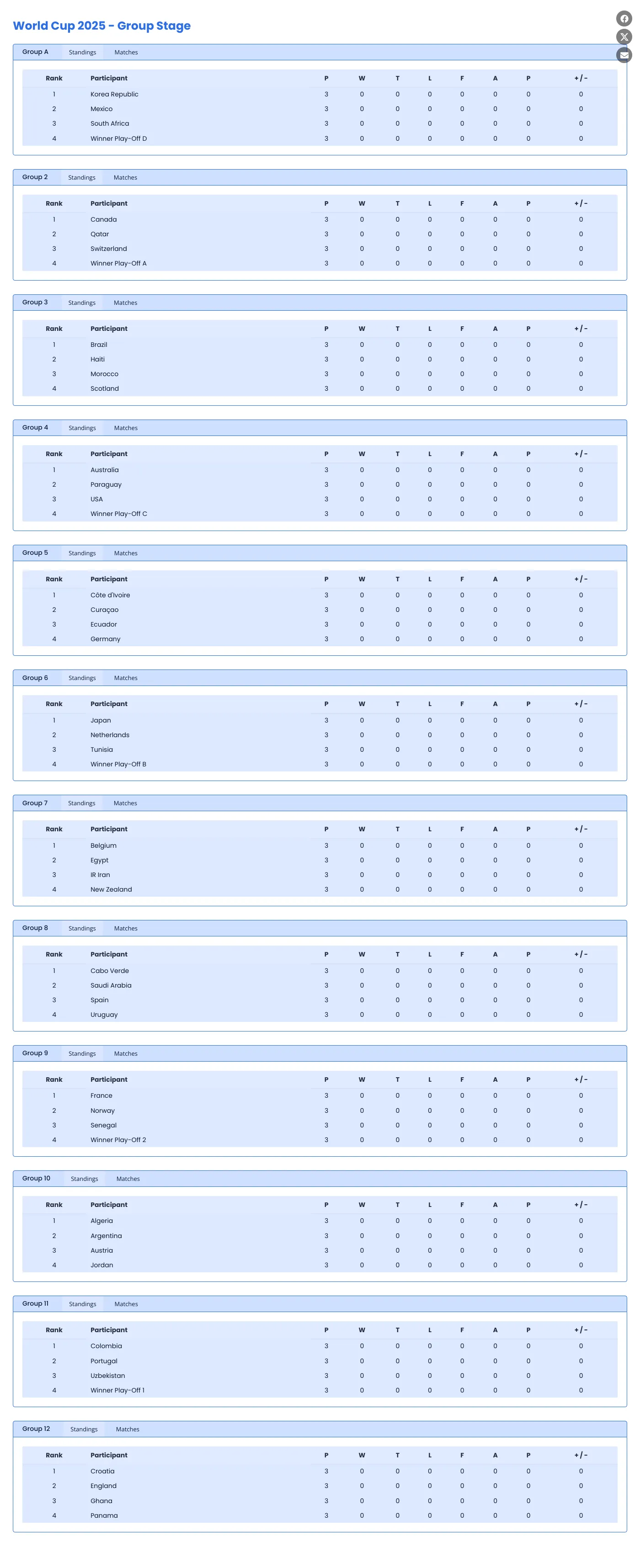
The December 2025 draw revealed all 12 groups and set the stage for compelling matchups throughout the tournament. The competition begins with these groups of four teams each, with the top two teams in each group and the eight best third-placed teams progressing to a new round of 32. This format creates more opportunities for teams to advance compared to previous tournaments. The total number of matches increases from 64 to 104, giving fans significantly more soccer to enjoy throughout the summer.
Each team still plays three group stage matches, maintaining the traditional round-robin format within groups. The expanded knockout stage now features five rounds instead of four, with teams reaching the final playing eight matches total rather than the previous seven. This additional round adds another layer of drama to the World Cup bracket as more teams compete for longer in the tournament.
The 12 Groups and Key Matchups
The December 2025 draw created 12 compelling groups with fascinating storylines throughout.
Group A features host nation Mexico alongside South Korea and South Africa, with a UEFA playoff spot to be determined.
Group B brings together Canada, Switzerland, Qatar, and another UEFA playoff qualifier.
Group C contains the highly anticipated Brazil versus Morocco rematch from 2022, alongside Scotland and Haiti.
Group D showcases host United States paired with Paraguay, Australia, and a UEFA playoff team.
Group E features Germany, Ecuador, Ivory Coast, and Curaçao, while Group F combines Netherlands, Japan, and Tunisia with a UEFA playoff participant.
Group G pairs Belgium with Iran, Egypt, and New Zealand, creating an intriguing mix of European, Asian, African, and Oceanic soccer.
Group H presents Spain against Uruguay, Saudi Arabia, and Cape Verde, while Group I delivers the mouthwatering France versus Norway clash alongside Senegal and an intercontinental playoff qualifier.
Group J features defending champions Argentina with Austria, Algeria, and Jordan.
Group K brings together Portugal, Colombia, and Uzbekistan with an intercontinental playoff spot, and Group L pits England against Croatia in a 2018 semifinal rematch, alongside Panama and Ghana.
These diverse matchups ensure compelling soccer from the tournament's opening match through the group stage conclusion.
The New Round of 32 Knockout Stage
The 2026 World Cup introduces an entirely new knockout round that previous tournaments never featured. Teams will now have to advance past four knockout rounds before reaching the World Cup final, including the new round of 32, followed by the usual round of 16, quarterfinal and semifinal. This additional round means more elimination drama and more matches to track on your World Cup bracket.
The round of 32 matchups depend on which groups the eight third-place teams emerge from, creating bracket paths that won't be fully determined until the group stage concludes. Group winners and runners-up face predetermined opponents based on the bracket structure, but the third-place qualifiers add complexity to predicting exact matchups. This uncertainty makes creating and following a World Cup bracket more dynamic than ever before.
Traditional knockout rules still apply throughout all elimination rounds. If matches end level after 90 minutes, teams play 30 minutes of extra time followed by penalty kicks if necessary. Every knockout match must produce a winner who advances on your World Cup bracket, creating the win-or-go-home tension that defines tournament soccer at its highest level.
Benefits of Using a World Cup Bracket Maker
A World Cup bracket maker becomes essential for managing the expanded 104-match tournament schedule. Instead of juggling multiple websites and apps to track games across 12 groups and five knockout rounds, you see the entire competition structure in one organized visual. This comprehensive view helps you understand how each result affects the tournament's progression and which teams advance through various pathways.
Interactive features let you make predictions before matches begin and update results as games conclude across different time zones. You can test scenarios for which third-place teams might advance, see potential knockout round matchups several rounds ahead, and track how your predictions compare to actual outcomes. The bracket maker turns the complex 48-team format into an engaging visual story you follow from opening day through the final.
Sharing capabilities transform your World Cup bracket into a social experience perfect for competitions with friends, family, or coworkers. You can compare predictions side by side, create scoring systems that reward accurate picks, and maintain leaderboards throughout the tournament's 39 days. These features build excitement as your bracket competition unfolds alongside the actual World Cup action across North America.
Host Nations and Opening Matches
The tournament opens June 11 with Mexico facing South Africa at Estadio Azteca in Mexico City, the iconic venue that has hosted two previous World Cup opening matches. Host Canada begins their campaign June 12 against a UEFA playoff qualifier in Toronto, while the United States kicks off at SoFi Stadium in Los Angeles against Paraguay on the same day. These three host nations benefit from playing all group stage matches on home soil, creating electric atmospheres for their tournaments.
The geographic spread across North America creates unique scheduling considerations for your World Cup bracket. Matches occur across four different time zones from Vancouver to Miami, spanning Eastern, Central, Mountain, and Pacific times. Understanding when games kick off in your local time becomes essential for following the tournament, especially when tracking multiple groups simultaneously throughout the opening two weeks.
A World Cup bracket maker handles these time zone complexities automatically, converting kickoff times to your location and preventing you from missing crucial matches. As games conclude across different cities and stadiums, real-time updates keep your bracket current throughout the competition's 39-day timeline. This automatic synchronization helps you maintain engagement with the tournament narrative as it develops across the continent.
Making Predictions for 48 Teams
Creating World Cup bracket predictions becomes more complex and engaging with 48 teams instead of 32. You must predict not only group winners and runners-up but also identify which eight third-place teams possess the statistics to advance. This additional layer of analysis requires understanding tiebreaker rules and considering multiple group stage scenarios when building your bracket.
The expanded format offers more opportunities for upset predictions and contrarian picks. With additional knockout rounds and more teams competing, your World Cup bracket can include calculated risks on emerging soccer nations or teams with favorable group draws. The larger tournament field means traditional powerhouses face longer paths to glory, creating space for breakthrough performances that make bracket predictions more unpredictable.
Consider creating different bracket variations to explore various tournament scenarios. One bracket might conservatively favor top-ranked teams, while another takes chances on underdog runs through the knockout stages. Multiple brackets let you test different prediction strategies and increase engagement throughout the tournament's extended timeline. The 48-team format provides enough variety that even experienced soccer fans will find surprising results that challenge their bracket assumptions.
Following the Tournament Timeline
The tournament will last 39 days, giving fans a longer window to engage with World Cup action compared to recent tournaments. The group stage occupies the first two weeks, with multiple matches each day across the 12 groups. Your World Cup bracket helps you prioritize which matches matter most for your predictions and which results could trigger tiebreaker scenarios.
The knockout stage timeline begins with the new round of 32, which alone features 16 matches that must be tracked on your bracket. After that comes the traditional round of 16, quarterfinals, semifinals, third-place match, and final. To make the final four, including the third-place game, four teams will play a total of eight games in the tournament. Following this progression through your bracket creates a narrative arc that builds tension from group stage through the championship.
The extended 39-day tournament allows for rest days between knockout rounds, giving teams recovery time while building anticipation for fans tracking their brackets. This pacing creates natural breaks where you can update predictions, analyze results, and adjust expectations for upcoming matches. The longer timeline transforms World Cup bracket tracking into a sustained experience rather than a condensed sprint.
Competing with Friends Using Bracket Pools
World Cup bracket competitions create shared experiences that connect soccer fans throughout the summer tournament. Setting up a bracket pool lets participants compare predictions, track standings, and celebrate or commiserate over results together. The 104-match format provides numerous scoring opportunities, making bracket competitions more dynamic than tournaments with fewer games.
Scoring systems can reward different types of predictions based on your group's preferences. Award points for correctly picking group winners, identifying advancing third-place teams, or predicting knockout round results with increasing value for later rounds. The World Cup bracket maker facilitates these custom scoring rules, automatically calculating standings so your competition stays current without manual tracking.
The 39-day tournament timeline lets bracket competitions develop storylines as leaders emerge and participants move up or down leaderboards. Unlike single-elimination tournaments that conclude quickly, the expanded World Cup format gives everyone chances to recover from early incorrect predictions. This extended competition period maintains engagement and provides conversation topics throughout nearly six weeks of soccer action.
Start Your World Cup Bracket Today
A World Cup bracket provides the essential organizational tool for following the expanded 48-team tournament from the opening match in Mexico City through the final at MetLife Stadium. Understanding the 12-group format, the new round of 32, and the progression through five knockout rounds helps you create accurate predictions and track results effectively throughout the competition's 39 days.
The 2026 tournament represents the biggest World Cup in history, with 104 matches creating unprecedented opportunities for bracket engagement. Whether you use a World Cup bracket maker to compete with friends, track your predictions, or simply organize your viewing schedule across three host countries and multiple time zones, the bracket format transforms passive watching into active participation.
The tournament begins June 11, 2026. Start building your World Cup bracket now to prepare for group stage predictions, identify potential knockout round matchups, and create the competition pools that will keep you engaged throughout the summer. The expanded format offers more soccer, more drama, and more opportunities to test your predictions against the world's greatest tournament.